Note: All the poetry excerpts seen below come from “Horatius at the Bridge,” by Thomas Babington Macauley. You can read the whole poem here.
Long before Rome became an empire, it was a city-state in central Italy, ruled by foreign kings. These kings were of a people called the Etruscans, who hailed from what is now Tuscany. In 509 BCE, the king of Rome was Tarquinius Superbus, also known as Tarquin the Proud. He was an arrogant and cruel man, and he made life exceedingly difficult for his Roman subjects. The last straw came when his son, Sextus Tarquinius, assaulted a Roman woman. Outraged at this crime, the people of Rome rose up and expelled the Etruscans from their city. Tarquin and his family were forced out of Rome, but this wasn’t the end. Tarquin gathered his allies and launched an attempt to retake the city. He went to the nearby city of Clusium, which was ruled by Lars Porsena. Porsena agreed to help Tarquin quell the uprising and the two of them soon marched at the head of a large army.
Rome was just one city at this time, facing a much larger and better-equipped enemy. They could not hope to defeat the Etruscans in a straight fight. The city seemed doomed.
But the Consul’s brow was sad,
And the Consul’s speech was low,
And darkly looked he at the wall,
And darkly at the foe.
“Their van will be upon us
Before the bridge goes down;
And if they once may win the bridge,
What hope to save the town?”
But a soldier named Publius Horatius Cocles, whom we now typically call Horatius, had an idea. There was only one bridge across the Tiber River. A small force could hold this bridge long enough to allow it to be torn down, though survival was highly unlikely for these brave soldiers. When he suggested this to the Senate, they could hardly believe that anyone would be courageous enough to volunteer for such a dangerous task.
Then out spake brave Horatius,
The Captain of the Gate:
“To every man upon this earth
Death cometh soon or late;
And how can man die better
Than facing fearful odds,
For the ashes of his fathers,
And the temples of his gods.
Despite the immense danger, Horatius volunteered to stand on the bridge himself, and called for others to help him.
“Hew down the bridge, Sir Consul,
With all the speed ye may;
I, with two more to help me,
Will hold the foe in play.
In yon straight path a thousand
May well be stopped by three.
Now who will stand on either hand,
And keep the bridge with me?”
Inspired by Horatius’ bravery, two senior officers, Spurius Lartius and Titus Herminius Aquilinus, volunteered to stand with him against the Etruscan army. Soon the three of them were on their way to the bridge, ready to stand against an army.
“Horatius,” quoth the Consul,
“As thou say’st, so let it be,”
And straight against that great array
Forth went the dauntless Three.
For Romans in Rome’s quarrel
Spared neither land nor gold,
Nor son nor wife, nor limb nor life,
In the brave days of old.
The Etruscan army, led by Lars Porsena and Tarquin the Proud, soon arrived at the bridge. They were surprised to see only three men standing guard at the bridge. Laughing at such a seemingly pitiful force, the Etruscans charged.
Four hundred trumpets sounded
A peal of warlike glee,
As that great host, with measured tread,
And spears advanced, and ensigns spread,
Rolled slowly toward the bridge’s head,
Where stood the dauntless Three.
The Three stood calm and silent,
And looked upon the foes,
And a great shout of laughter
From all the vanguard rose:
And forth three chiefs came spurring
Before that deep array;
To earth they sprang, their swords they drew,
And lifted high their shields, and flew
To win the narrow way;
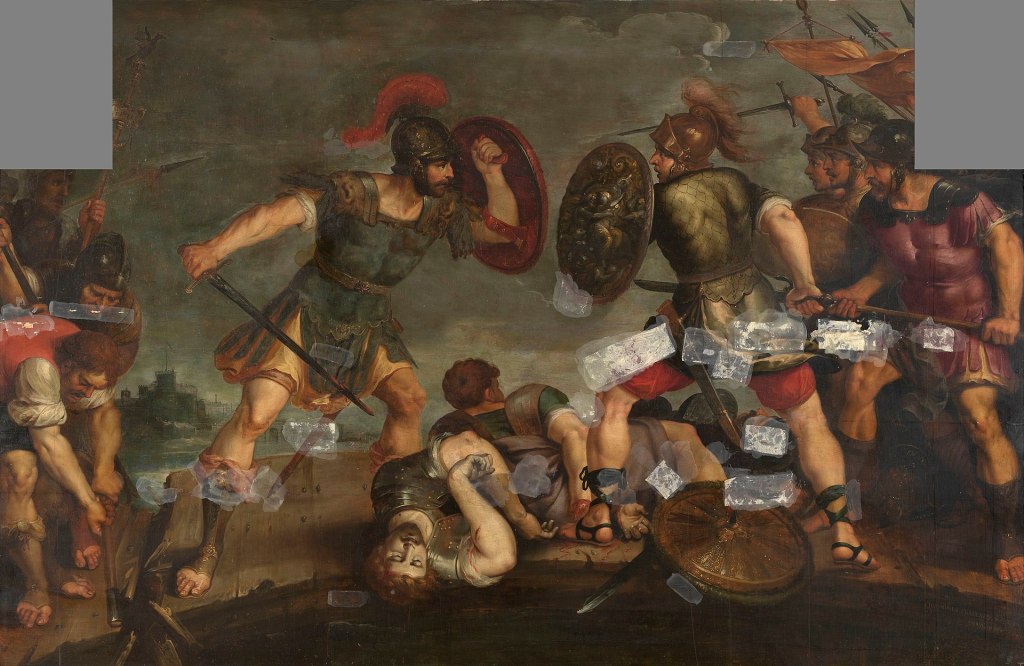
The dauntless three stood valiantly, holding the bridge from the Etruscan army while the other Romans worked to bring it down. They fought hard, and made an entire army stop its advance before only three men. Eventually, the bridge was on the verge of collapsing. Lartius and Aquilinus retreated and ordered Horatius to follow them across, but Horatius refused to abandon his position, not thinking their victory was yet secure. He piled the Etruscan dead into makeshift barriers and continued to fearlessly battle on his own, even after receiving multiple wounds.
As the bridge began to fall, Horatius dived into the Tiber. Weighed down by his armor, holding onto his weapons, and with an Etruscan spear sticking out of his leg, he swam against the current to the Roman shore.
And fiercely ran the current,
Swollen high by months of rain;
And fast his blood was flowing,
And he was sore in pain,
And heavy with his armour,
And spent with changing blows:
And oft they thought him sinking,
But still again he rose.
Horatius was joyfully received by the Romans on the riverbank and was carried into the city. The wounds he had sustained in the battle were such that he could no longer serve in Rome’s army, but the grateful city gave him a generous pension, in addition to his military awards. They gave him enough land for two oxen to plow in a day, which allowed him to live comfortably for the rest of his life. The tale of Horatius and his brave defense of Rome has lasted through the ages, a testament to this man’s incredible courage. Over two and a half thousand years later, we still remember Horatius and how he kept the bridge in the brave days of old.
When the goodman mends his armour,
And trims his helmet’s plume;
When the goodwife’s shuttle merrily
Goes flashing through the loom,—
With weeping and with laughter
Still is the story told,
How well Horatius kept the bridge
In the brave days of old.
 muscularhistory.com