
Heracles, better known by his Roman name Hercules, was the greatest of all the Greek heroes. He was the son of Zeus with the mortal woman Alcmene. Hera was outraged at Zeus’ infidelity, but was unable to strike at him directly. Instead, she focused her efforts for revenge on Heracles.
When Heracles was an infant, Hera sent two snakes into his crib in an attempt to kill him. However, even as a baby Heracles was supernaturally strong. He simply lifted the snakes up, one in each hand, and strangled them. Hera’s plot was foiled, but she would continue to hound Heracles for the rest of his mortal life.
Heracles was best known for completing his legendary 12 Labors. There is no single definitive version of these labors, the order in which Heracles performed them and the details of the labors themselves greatly vary between accounts.
The story of the labors began when Hera infected Heracles with a murderous insanity. Heracles killed his wife, Megara, and their children before regaining control over his senses. Horrified at his actions, Heracles visited the Oracle at Delphi and asked how he could atone. The Oracle told him to journey to the city of Tyrins. There he would serve the king, who was also his cousin, Eurytheus. Heracles would be bound to Eurytheus for ten years, during which time he would perform ten great labors. Only after completing this period of servitude would Heracles have atoned for his crime.
Labor 1: The Nemean Lion
The first four labors involved fighting dangerous monsters, which were terrorizing the people of Greece. For the first labor, Heracles had to fight the Nemean Lion.
The offspring of Typhon and Echidna, the Nemean Lion had an impenetrable hide, and razor-sharp claws. Heracles was not aware of this at first. He gathered some arrows when he arrived in the nearby town of Cleonae. He attempted to slay the lion with these ordinary weapons, but they simply bounced off. Heracles needed to think of another way to kill the beast.
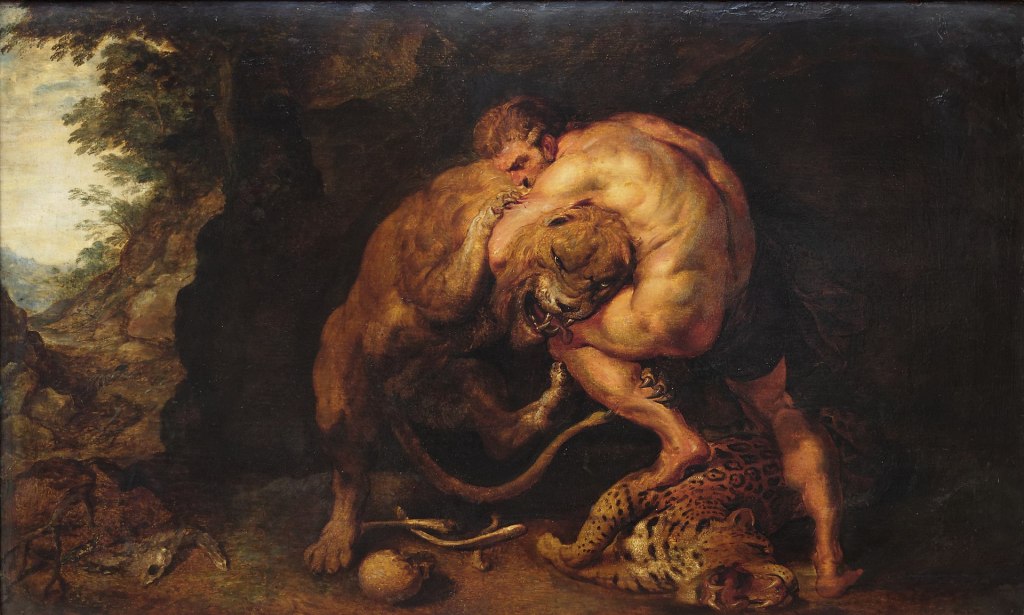
Heracles blocked the entrances with boulders and ambushed the lion in its lair, engaging it in a wrestling match to the death. He could not cut through the hide, but that was not necessary when he could grapple with the lion. After a long and difficult battle, Heracles got his arms around the lion and choked it to death. He then skinned the lion with its own claws, the only thing that could penetrate its hide. He turned the lion’s hide into a coat, which protected him for the rest of his adventures.
Labor 2: The Lernaean Hydra
The Lernaean Hydra was a reptilian monster with nine heads and deadly poisonous blood. When one head was cut off, two more would immediately spring up in its place. The more you wounded the Hydra, the more dangerous it became.
With the Hydra, Heracles showed his cleverness. His great strength was of rather limited use, so he had to rely on his mind. Eventually, he figured out that he could stop the heads from growing back if he quickly plugged the stump with a burning torch, but if he did it on his own the other heads would attack while he was vulnerable. He devised a plan with his nephew, Iolaus. Heracles would cut off the heads and Iolaus would burn the wound before it could regrow. They repeated this strategy and cut off more heads. Seeing that Heracles and Iolaus were winning, Hera sent a crab to distract them. This did not provide a distraction for long, however, as Heracles was able to kill the crab by stomping on it. Soon all of the heads were cut off and the monster was dead.
Heracles took his arrows and dipped them in the Hydra’s blood, which was lethally venomous. He would use these arrows many times throughout his adventures. When he returned to Tiryns, Eurytheus refused to accept this labor on the grounds that Heracles was aided by Iolaus. Despite his great feat, he still had nine labors to go.

Labor 3: Ceryneian Hind
The Ceryneian Hind was a female deer with golden antlers and bronze hoofs which was sacred to the goddess Artemis. For this reason, killing the Hind would be a very bad idea. Even a great hero like Heracles would not want to anger a goddess. One goddess hounding him was bad enough, angering a second was the last thing he wanted to do. Eurytheus had seen Heracles fell dangerous beasts in the previous labors. Here, he hoped to force Heracles to invoke the wrath of Artemis.
Knowing the danger but having no choice, Heracles set off to capture the Hind. After catching a glint from its golden antlers, he pursued it. However, it was supernaturally quick and was not easy to approach. For one year, Heracles followed the sacred creature. He chased it all throughout the land. He traveled from the mountains of Greece to the far northern lands of Hyperboria, and back again. Eventually, Heracles managed to wound the Hind with an arrow to the forelegs, allowing him to finally reach the creature and carry it back to Eurytheus. On the way, the goddess Artemis appeared in front of him and demanded to know what he was doing with her sacred animal. Heracles explained that he was forced to capture the Hind as part of his penance and begged for forgiveness. Artemis used her power to heal the wounds on the beast and agreed to let Heracles take it back to Eurytheus. As he was forgiven by Artemis, Eurytheus’ plan had failed. When Heracles took the Hind to the palace, it immediately sprinted away, adding to Eurytheus’ failure.

Labor 4: Erymanthian Boar
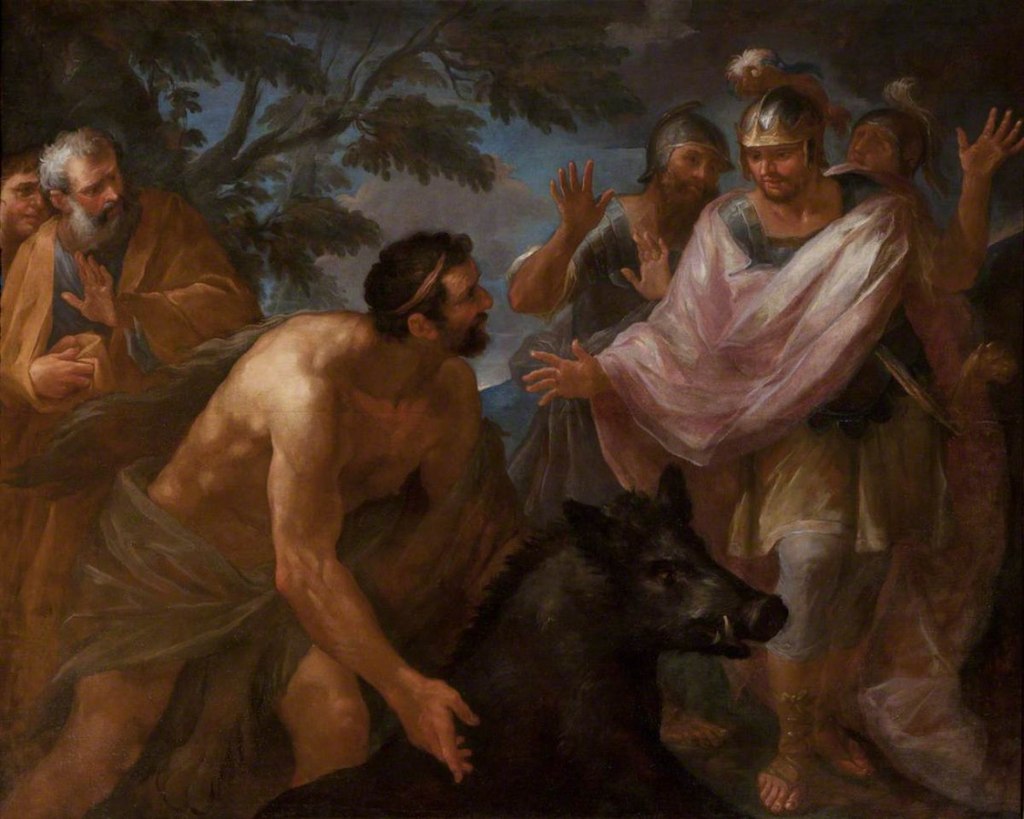
For his fourth labor, Heracles had to bring the ferocious Erymanthian boar back to Eurytheus alive. Since this monster was incredibly strong and tenacious, bringing it back alive would not be an easy task. Heracles went to the wise centaur Chiron for advice. Chiron told Heracles to trick the Boar into charging into the deep snow. There, it would be trapped. Following this advice, Heracles managed to bind the Boar while it was in the snow. Carrying it on one shoulder, he then went back to the palace. When Eurytheus saw the Boar, he was so frightened that he hid in a massive urn and commanded Heracles to take it away.
Labor 5: The Augean Stables
For the fifth labor, Eurytheus commanded Heracles to clean the stables belonging to King Augeas. They had not been cleaned in 30 years, and was inhabited by over 1,000 cattle. Furthermore, these cattle were supernaturally healthy, and therefore produced an exceptional amount of manure. With this labor, Eurytheus wanted a task that would humiliate Heracles and not give him more glory.
When Heracles arrived at the stables, he asked Augeas to let him take one-tenth of the cattle if he could clean it in one day. Believing this to be impossible, Augeas agreed. With the deal settled, Heracles went to work. He redirected the nearby Alpheus and Peneus rivers to flow into the stables, washing them out in short order. However, Augeas refused to honor his contract. Heracles challenged him in court, and was supported by Phyleus, Augeas’ son. Before the court came to a decision, Augeas exiled both Heracles and Phyleus. Heracles soon returned to the kingdom and killed Augeas, placing Phyleus in power.
Upon returning to Tiryns, Eurytheus refused to recognize this labor as completed, on the grounds that Heracles used the rivers to clean the stables rather than doing it himself. Also, he objected to Heracles accepting payment for the deed. Heracles still had more labors to complete.

Labor 6: The Stymphalian Birds
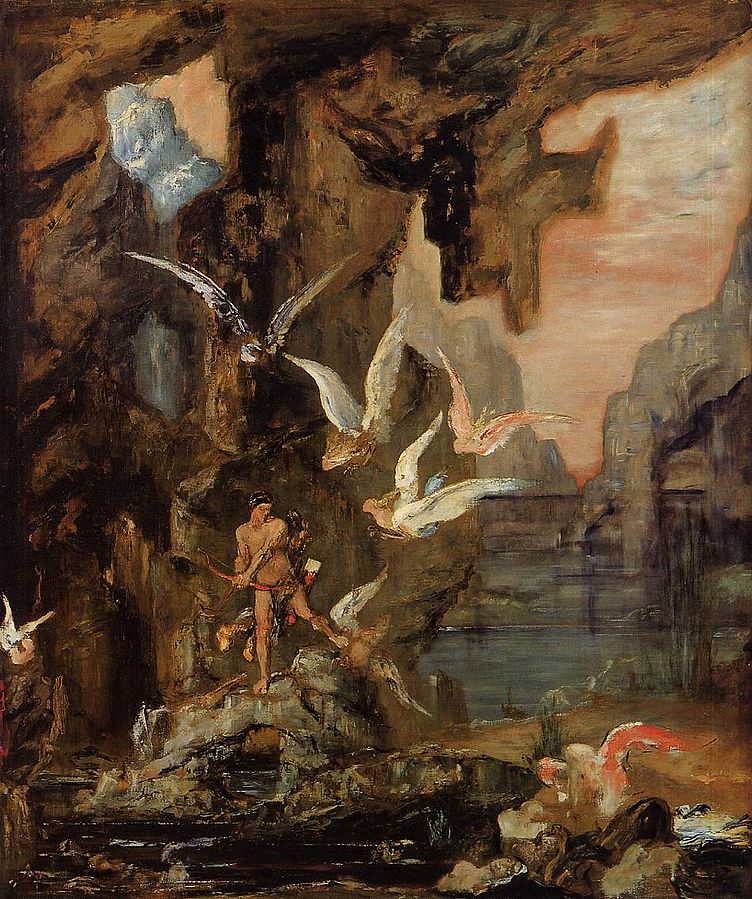
For the sixth labor, Heracles had to deal with a large group of fearsome birds dwelling by the marsh by Lake Stymphalia, in Arcadia. These birds had metal feathers, which they could throw at their enemies, and sharp bronze beaks. They had been terrorizing the nearby villages for some time, attacking people and destroying crops. Heracles soon found that he could not enter their swamp, as he was too heavy and would sink to the bottom. Athena soon appeared and gave Heracles a rattle made by Hephaestus. He shook and rattle, and the Birds flew off out of the trees. Heracles shot as many as he could with his bow, but many flew away. Still, they were no longer terrorizing the nearby people, and the labor was complete.
Labor 7: The Cretan Bull
For this labor, Heracles had to sail to Crete in order to capture the magnificent white bull which had fathered the Minotaur. Minos readily agreed to let Heracles take the Bull, as it had been causing much destruction in the countryside. He even offered to give Heracles assistance in capturing the beast, but the hero declined. After all, he did not want to risk having another labor discounted.
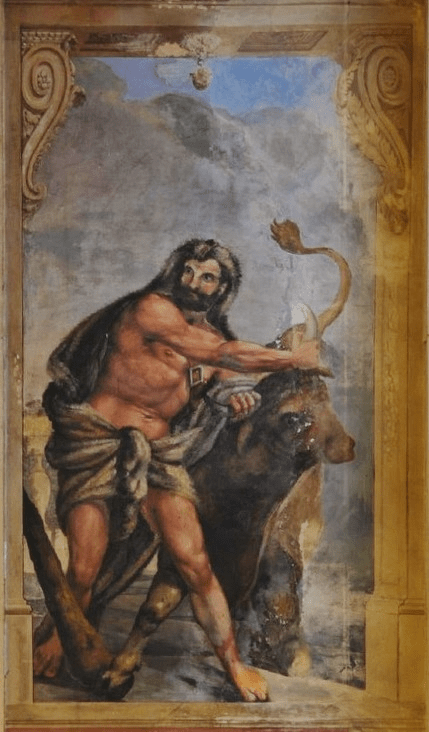
Heracles crept up behind the Bull and leapt on its back. He wrapped his arms around the Bull’s neck and choked it until it passed out, but stopped before it died. He tied the Cretan Bull up and they traveled back to Eurytheus, who again hid when he saw it. He intended to sacrifice the Bull to Hera, but she refused. She did not want her sacrifices to bring and glory to Heracles. Instead, the Bull was set free. It eventually wandered to Marathon, where it would cause more trouble. That is another story, however.
Labor 8: The Mares of Diomedes
Heracles now had to steal four mares, which belonged to the mad king Diomedes. He trained them to eat the flesh of anyone who displeased him, and mistreated them so they would be vicious and aggressive to any interlopers.
Heracles captured Diomedes and fed him to his own horses. After eating their master, the mares’ madness was cured. They were now docile enough that Heracles could lead them back to Eurytheus. Upon receiving the newly calm horses, Eurytheus dedicated them to Hera and allowed them to roam free.

Labor 9: The Belt of Hippolyta
Heracles needed to retrieve the sword-belt belonging to Hippolyta, Queen of the Amazons. When he arrived in Themiscyra, the home of the Amazons, Hippolyta was so impressed with Heracles that she gave him her belt willingly. That would have settled the matter, but Hera disguised herself as an Amazon and spread the rumor that Heracles was kidnapping their queen. They launched an attack on Heracles and Hippolyta, but the hero was too strong for them. He easily felled multiple Amazons with a single swing of his club. He escaped with the belt, but Hippolyta was killed in the fight.

Labor 10: The Cattle of Geryon
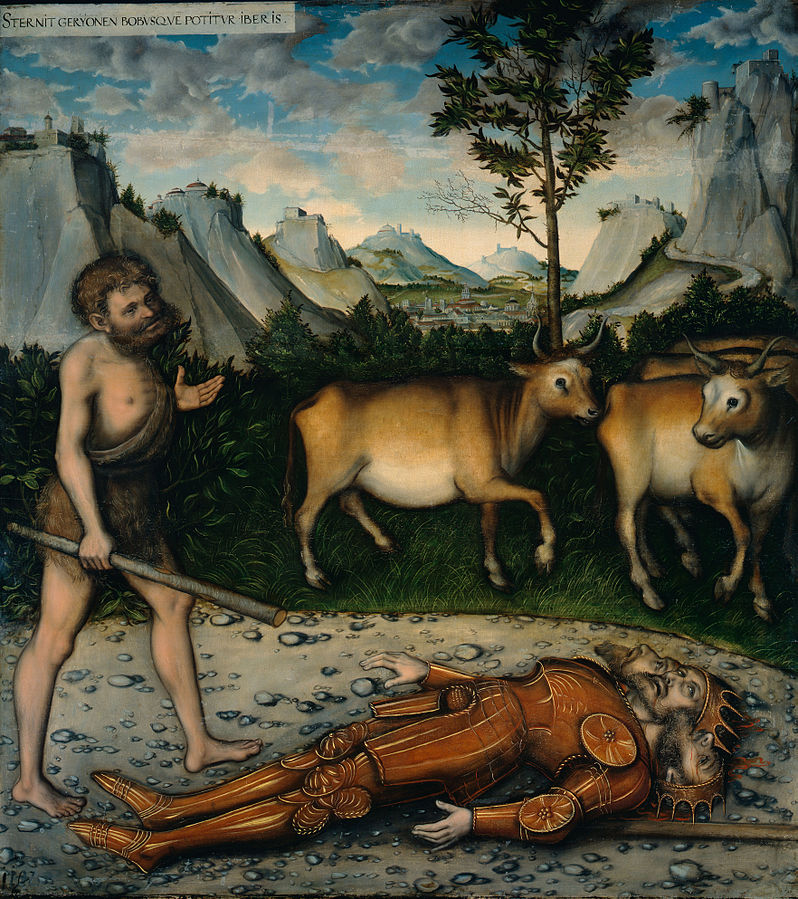
For his tenth labor, Heracles needed to take the herd of cattle belonging to the beast Geryon. Geryon was a fearsome giant who had either three heads or three bodies atop one pair of legs, depending on the source. Heracles traveled to the far west, trying to reach the island of Erytheia. On the way, he was crossing the desert and grew so tired of the heat that he pointed an arrow at the sun and threatened to shoot it. Helios, the sun god, was so impressed by Heracles’ audacity that he presented the hero with a magical golden cup. He was able to ride this cup across the land and reach his destination easily.
Orthrus, a two-headed dog, attacked Heracles as soon as he landed on Erytheia. Heracles easily dispatched the dog with his club. However, the commotion attracted the notice of Geryon, who ran to attack Heracles himself. The monster was enormous, and stabbed three spears at Heracles while protecting his body with three shields. Heracles dodged the blows and managed to fire one of his poisoned arrows at one of Geryon’s heads, killing him. The giant crumpled over, and Heracles went about gathering the cattle.
Hera made a mayfly bother the cattle, causing them to scatter across the world. Heracles chased them down, finding them in many different places. After nearly a year of searching, he had finally gathered all the cattle and delivered them to Eurytheus.
Labor 11: Golden Apples of the Hesperides
Heracles now needed to take three golden apples from the Garden of the Hesperides, the nymphs of the evening. No mortal knew the way to their garden, but Heracles knew how he could find out. He climbed to the top of the mountain where Prometheus lay bound, with an eagle devouring his regenerating liver every day. Heracles shot the eagle with his poisoned arrows and broke the chains binding the titan to the rock. In gratitude, Prometheus gave Heracles the location of the Garden of the Hesperides. The titan was free, and the hero set off for the garden.

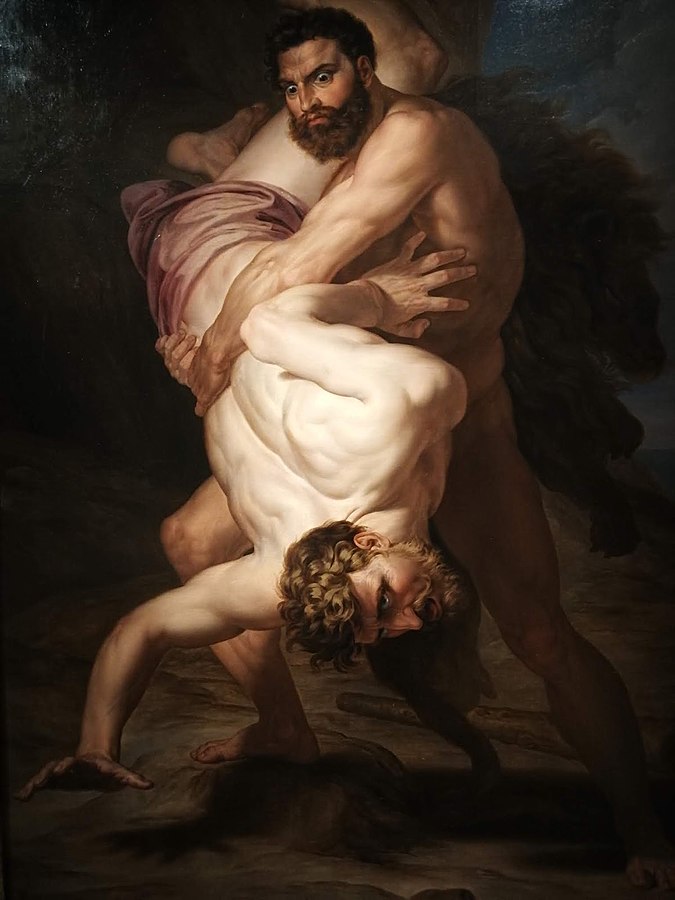
On the way, Heracles came across the wrestler, Antaeus. He was a son of Poseidon and Gaia, who was invincible as long as he was in contact with his mother, the earth. He would challenge all passersby to matches. As soon as anyone forced him to the ground, he would regain his strength and be able to win. He killed all of his opponents and made a temple to his father out of the skulls of his victims.
When Heracles fought Antaeus, he soon found himself with the same problem as all of the other challengers. No matter how hard Heracles threw Antaeus to the ground, he would spring back to life again and again. Eventually, Heracles figured out a way to win. If Antaeus would be invincible as long as he touched Gaia, then Heracles would simply not let him touch her. He picked up Antaeus in a bear hug, and squeezed him until he was dead. Heracles had won, and was able to continue on his way.
Eventually, Heracles arrived at the garden of the Hesperides. In one version of the myth, the apple tree was guarded by the dragon, Ladon. Heracles slew Ladon with his arrows and left the garden. In another version, there was no dragon, but Heracles learned that he could not take the apples from the tree without dying. Although he was a son of Zeus, he was still mortal. Luckily for him, the Titan Atlas was in the area, holding up the sky. He talked to Atlas and arranged to hold up the sky for him in exchange for the Titan procuring the apples. Atlas walked over and took the apples, but he was enjoying his newfound freedom. He told Heracles that he would take the apples back to Eurytheus himself and return when the job was done. Heracles was not fooled, however. He knew that Atlas would not return. He asked Atlas to hold up the sky briefly while he adjusted his Nemean Lion skin, in order to pad his shoulders. While Atlas held up the sky, Heracles ran away. He returned the apples to Eurytheus, and the labor was complete.

Labor 12: Cerberus
For his final labor, Heracles had to retrieve Cerberus, the three-headed dog that guarded the entrance to the underworld. Naturally, this meant Heracles had to enter the land of the dead and return alive. This was an incredibly daunting proposition, even for one as mighty as Heracles. To prepare for his descent into Hades, he underwent the initiation into the Eleusinian Mysteries.
Heracles entered the underworld, and while passing through he came upon the fellow hero Theseus and his companion Pirithous. They sat in chairs of forgetfulness, without any memory of their home. Heracles was able to pull Theseus from his chair, but a piece of his thigh remained behind. He was not, however, able to free Pirithous, as he was fated to remain in Hades. Upon reaching Hades himself, Heracles asked for permission to take Cerberus to Eurytheus. Hades agreed, on the condition that Heracles to subdue and take the dog himself. These terms were acceptable to Heracles, who used his bare hands to knock out Cerberus. Carrying the beast on his back, he returned to Tiryns. Upon arriving, Eurytheus again hid in an urn until Heracles released Cerberus, who then returned to his master in the underworld. With this, Heracles had completed his labors and was now finally free.

Heracles continued to have many adventures after completing his labors. He sailed with the Argonauts on their quest for the Golden Fleece. He built massive pillars at the end of the world, which held up the sky and freed Atlas from his sentence. He challenged the god Dionysus to a drinking contest, although he lost. Upon his eventual death, he ascended to Mount Olympus and became a god himself, even making his peace with Hera. Despite all his later adventures, the Twelve Labors remains his most well-known feat.
 muscularhistory.com