The Greek city-states were well-accustomed to warfare. They fought against each other or against foreign powers on a frequent basis. While they had no professional armies, save for Sparta, their citizens were able to make an effective defense of their home. While the cities were each self-governing, they made use of similar tactics and types of troops.
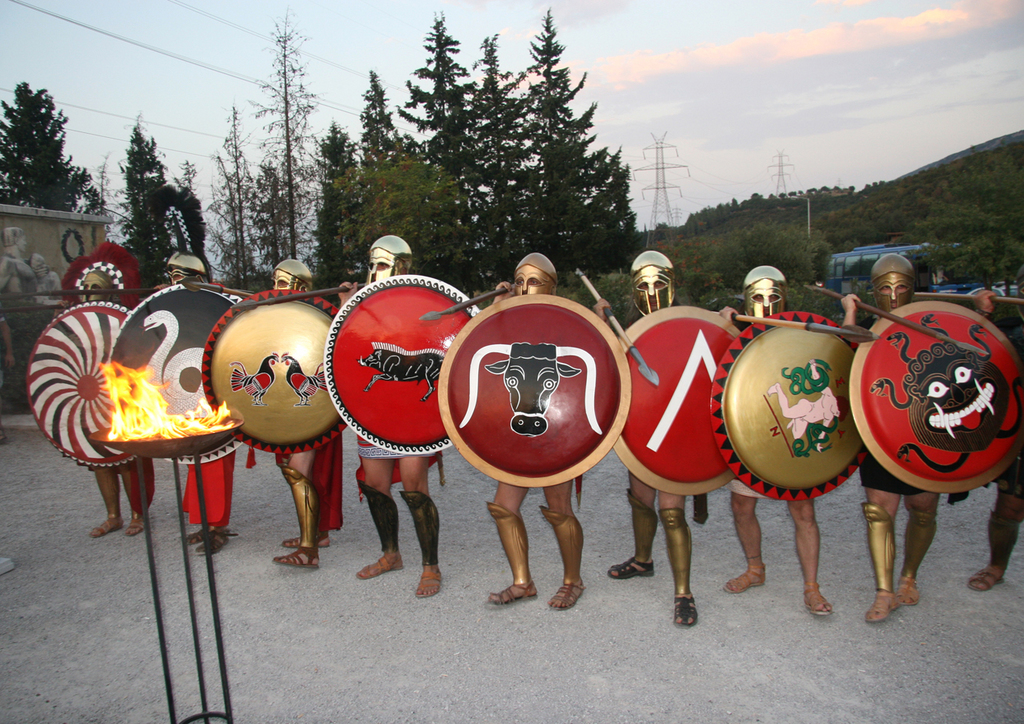
Greek armies were based around the hoplite, a heavily armored soldier with a large shield and one-handed spear. The shield, which was called a hoplon or aspis, was circular, about three feet in diameter. It was made mostly of wood, but sometimes capped with bronze. It was quite heavy, ranging from about seventeen to over thirty pounds, and was often used as a weapon in its own right. The spear was called a doru, or dory. It ranged from about six and a half feet to just under ten feet in length and the shaft was about two inches in diameter. A shortsword, called a kopis, served as a sidearm. There was also a leaf-shaped stabbing dagger called a xiphos, which was sometimes used instead of, or in addition to, the kopis.

The hoplon stretched from the hoplite’s shoulders to his knees. The rest of his body was protected by a helmet, which covered the face, and a set of greaves to protect his legs. His torso was protected by a cuirass. Most commonly this was made out of treated layers of linen and called a linothorax. It is difficult to know much about the linothorax, as no examples have survived. Linen could make effective armor, but it is more biodegradable than metal. We only know of it through writings and artwork. Some historians have made efforts to construct the armor themselves.
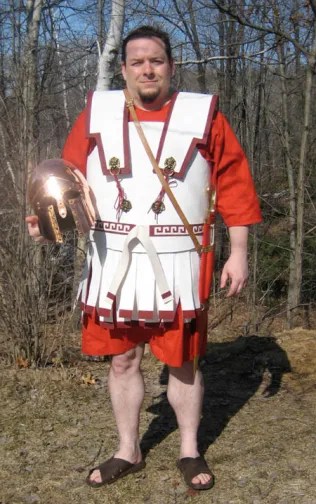
Wealthier hoplites would wear a cuirass made from bronze, like the helmet and greaves. With the best equipment, the full set was very heavy, weighing up to seventy pounds. This wasn’t necessarily a drawback, though. As they spent most of the battle holding the line, this extra weight made them even more difficult to move.
The equipment was not standardized. Each hoplite had to provide his own equipment, leading to much variation in quality and appearance. The hoplites bought whatever they could afford, and it could be quite expensive. They typically held onto the equipment as long as possible, passing it down from father to son. The poorest hoplites would wear no armor at all. They fought with only the spear and shield, which were necessary for fighting in formation.

The exception to this rule was in Sparta, where the equipment was provided by the state. Most Greek armies had a variety of designs on the shields, but every Spartan hoplon displayed just the lambda, for Laconia. Sparta had a much more centralized government structure than the other city-states. The government owned and provided just about everything.

Hoplites fought in a formation called the phalanx. The soldiers stood extremely close to each other, with every man using his shield to cover the man to his left. They formed a wall with their shields, with the men standing in multiple rows behind the front line. The phalanx was typically eight rows deep, but this could vary. The spears were arrayed forward in multiple rows, creating both a sturdy defense and a formidable offense. They would thrust their spears at the enemy while holding their shields in place. If enemy soldiers got in close, the hoplites would bash them with their shields, pushing the enemy back.
The hoplites were supported by many different types of light infantry, mostly taken from poorer families who could not afford the proper equipment to fight in the phalanx. These forces were collectively referred to as the psiloi. They mostly focused on ranged combat, including slingers, stone throwers, and javelin throwers. Greek armies did not make heavy use of archers, and when they did appear they were typically non-Greek mercenaries. The exception was the armies of Crete, which did use native archers. These ranged soldiers collectively provided support while the hoplites held the line.
Cavalry were always part of the armies in Greece, but at first saw relatively limited use. Only the wealthiest members of Greek society could afford the horses and equipment needed, meaning that the cavalry were typically the commanders. Massed cavalry charges were not very common in the Greek world. After all, a frontal assault on a phalanx would have been suicide. For most of ancient Greek history, the cavalry would have issued orders but otherwise have taken very little action on the field. This gradually changed over time. By the Peloponnesian War, cavalry was used for scouting, flanking maneuvers, and chasing down fleeing soldiers. They still did not make frontal assaults, because no sane person would do that against a phalanx. Under Alexander the Great, the Macedonian army would expand the role of cavalry even further, with them being highly effective against the forces of the Persian Empire. Alexander himself was well-known for riding into battle with his elite Companion Cavalry. His horse, Bucephalus, became famous in his own right.

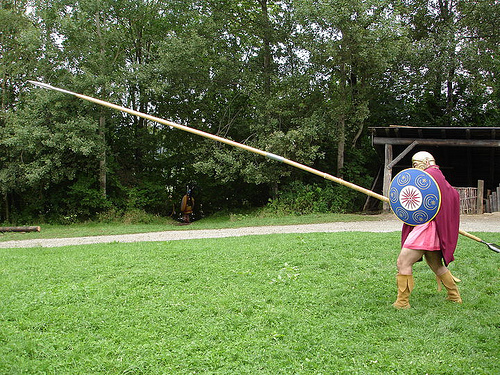
The equipment evolved over time. The Macedonian army, under to command of Phillip II, father of Alexander the Great, replaced the dory with a much larger weapon called the sarissa. This was an enormous spear, ranging from thirteen to twenty feet in length and weighing between twelve and fourteen pounds. The sarissa had to be wielded with two hands, so the hoplon fell out of use. Instead they used a smaller shield which could be strapped to their arm. The use of longer spears allowed the Macedonian phalanx to be deeper than the Greek formations, typically sixteen rows deep. The first five rows would point their spears forward, while the rows farther behind would angle their sarissas upwards in order to provide cover from arrows.
Naval combat in the ancient Greek world was dominated by the trireme. This ship was a galley with three decks of rowers, one man to an oar. Combat would involve ramming the enemy ships with the prow, which was capped with bronze. Each ship was basically a guided missile. Other sizes of ships were used as well. The bireme was a smaller vessel with two decks of rowers. By the rise of Rome, the trireme had fallen out of favor as the main warship and was replaced with the quadrireme and quinquereme, with four and five decks, respectively.

Contrary to what you often see in movies, the rowers were not typically slaves. Instead, they were free citizens. In Athens, working as a rower was an integral part of the lower classes’ military service. The reason is simple. In the midst of a battle, you do not want to give your enemy a fresh supply of troops just below decks. It is of significant benefit if the people responsible for your ship’s propulsion are genuinely on your side.
Wars in ancient Greece were typically rather small in scale. Individual city-states could not field very large armies. Except for Sparta, every Greek city’s soldiers held civilian jobs, such as farming or fishing, which they needed to perform in order to keep the city functioning. This made wars more dependent on the season, as farmers needed to produce food. This meant that wars were often only fought in the summer. In Sparta, they had slaves, called helots, to manage these jobs. However, the soldiers still could not leave for too long, out of fear that the helots would revolt if given the opportunity, as they often did.
Warfare in the Greek world reached a much greater scale with the Greco-Persian Wars, beginning in 499 BCE. The Achaemenid Empire, which controlled Persia, was absolutely enormous. It stretched all the way from Thrace in the west to the Indus River in the east, and from Crimea in the north to Egypt in the south. It was the largest empire in human history at this point in time, and was obviously able to field vastly larger forces than any individual Greek city. The Greeks could only survive by fielding allied armies, which they did to great effect.
 muscularhistory.com


