Xerxes’ invasion of Greece began in 480 BCE. Ten years had passed since his father’s disastrous defeat at Marathon, and he was focused on revenge. He had spent several years mustering an absolutely enormous force with which to crush any Greek opposition. It is impossible to know the exact numbers, but it is estimated the total invasion force consisted of 300,000 to 500,000 men. They crossed the Hellespont and marched to Thessaly, passing through Thrace and Macedon on the way. They were met at Thermopylae by a combined Greek army totaling about 7,000 soldiers, led by 300 Spartan hoplites.
At the time of the invasion Sparta was again celebrating the Festival of Carnea, in honor of Apollo. This time, the Spartan leadership deciding that the situation was urgent enough to take action immediately. They sent an expedition by one of its two kings, Leonidas I, to gather allies and block the pass, but did not commit a large army, only sending a tiny force of 300 men.
Thermopylae was a narrow pass with mountains on one side and the sea on the other. The name, meaning “hot gates” in Ancient Greek, was given to the area because its many hot sulfur springs led people to believe that it contained a gateway to Hades. The narrow area meant that the Greek army could completely block the pass and prevent the Persian army from using its much larger size to its full advantage. With the Persians only able to fit a small portion of their forces in at a time, their numbers were not so much of an advantage. Leonidas chose to defend the middle of the pass, which was its narrowest point. This was also considered a good place to defend because a wall was in place which had been built by the Phocians sometime earlier. The only weakness was a mountain pass which could potentially be used to flank the Greek army. As a precaution, Leonidas posted 1,000 Phocian soldiers at the pass.
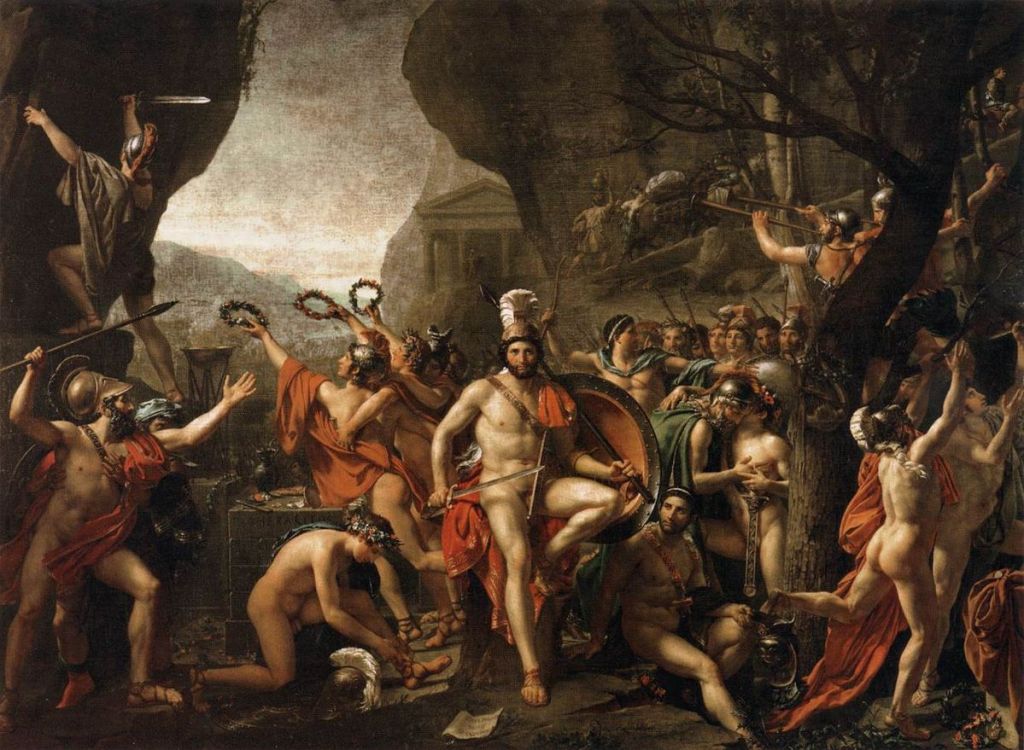
Before the battle began, the Persians sent an emissary to the Greek leaders. The Greeks were offered the status of “Friends of the Persian People,” which meant they had self-rule, and the ability to settle on other lands. These terms were rejected. The emissary warned of the Persians’ archers, who could fire so many arrows they would block out the sun. The Spartans said that all that meant was they would fight in the shade. The Persians ordered the Greeks to hand over their arms. Leonidas’ reply became legend: molon labe, or “come and take them.”
Xerxes waited for four days after the Greeks refused to surrender, not believing that they would be willing to stand against his army. Eventually, he decided the Greeks would not disperse and sent his forces in to attack. The Persian army began with a volley from 5,000 archers, which true to the emissary’s word blocked out the sun. Even so, the arrows were completely ineffective, and the Spartans fought in the shade. The shields and armor of the Greek hoplites made the arrows simply bounce off. Seeing how the archers could make no progress against the Greeks, Xerxes sent in 10,000 infantry to bring the Greeks before him. At the wall, the Greeks held their ground. They rotated troops to prevent fatigue and easily cut the Persians down. Herodotus wrote that Xerxes stood up three times in shock while watching the battle. The Persian force was thoroughly slaughtered while the Greeks only took a few casualties for their efforts.
After seeing his regular infantry destroyed with very little effort on the part of the Greeks, Xerxes then sent in his elite infantry, the 10,000 Immortals. Little is known for certain about these soldiers, but Herodotus claimed that they wore scale armor, carried wicker shields wrapped in leather, and were armed with short spears and swords. It has often been said that whenever one died, he was immediately replaced. This kept the strength always at 10,000 and gave the illusion that they could not be killed.
Despite their exceptional training and fearsome reputation, they proved no more effective against the Greeks than their less elite counterparts. Herodotus wrote that the Greeks used a feigned retreat tactic against the Immortals and cut them down when they tried to pursue. After the disaster of the Immortal charge, Xerxes called off attacks for the rest of the day. After one day of holding the pass, the Greeks were still nearly at full strength and the Persians had lost thousands.
On the second day Xerxes sent another wave to attack the Greeks, reasoning that they must have taken losses and be too exhausted by now to put up the same level of resistance. To his surprise, it went much the same as the previous day’s battles. After seeing more of his soldiers annihilated, he called off further attacks and retreated to the camp to consider his next move. He received a stroke of luck when a Greek named Ephialtes, motivated out of a desire for a reward, came to the Persian camp and informed them of the passage at which Leonidas had posted the 1,000 Phocians. Xerxes took his advice and sent his men to scope out the passage.
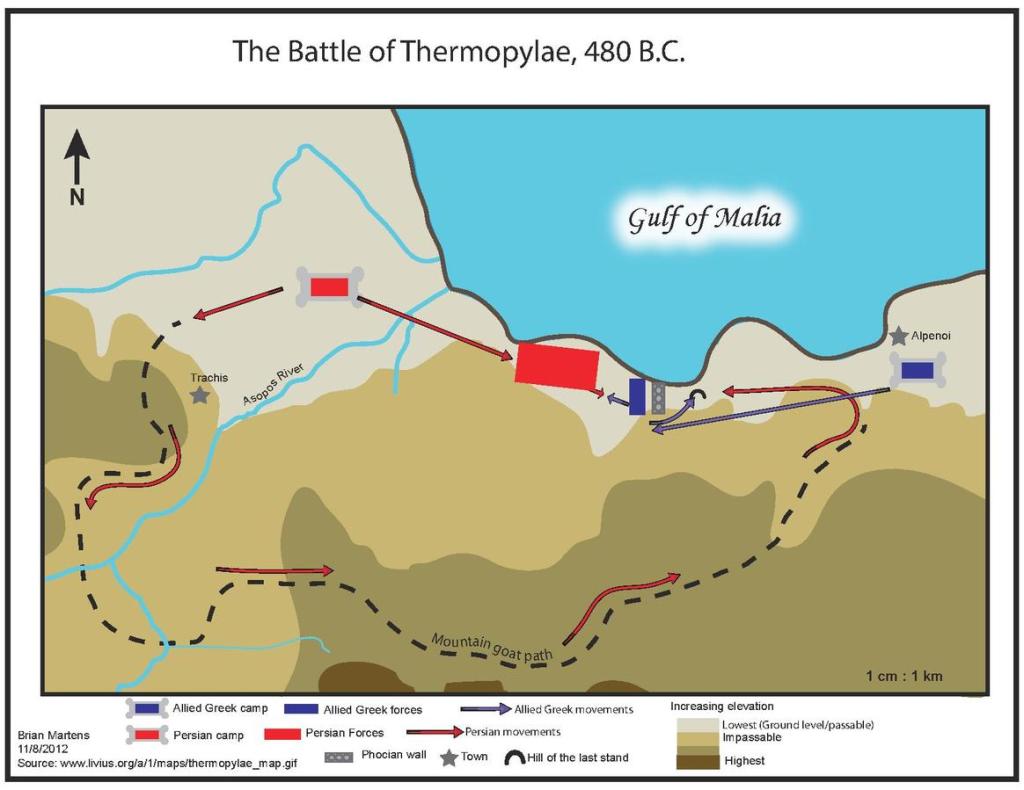
Upon hearing that the Persians discovered the pass, Leonidas called for a war council. It was decided that the bulk of the Greek forces would retreat back to prepare their home cities for war, while the 300 Spartans remained to slow down the Persian army. Much to the surprise of the Spartans, the 700 Thespians present also refused to leave, instead choosing to stay and hold off the Persian advance for as long as possible. The Spartans were deeply impressed by the bravery of the Thespians, as they were not professional soldiers like the men of Sparta. They were ordinary men, of a variety of trades, who rose to the occasion because it was necessary.
As the third day of the battle dawned, the remaining Greeks were surrounded. With Immortals behind the Greeks, 10,000 light infantry and cavalry charged the front. Knowing they would soon lie dead, the Spartans and Thespians charged out to meet their enemies, intent on taking as many Persians with them as possible. Herodotus stated that the Greeks first fought with their spears. When the spears broke, they switched to their swords. When they lost their swords, they switched to their bare hands and teeth. They never surrendered, despite knowing that the situation was hopeless.
Despite having the Greek army surrounded, the Persians took many casualties before they won the day. Two brothers of Xerxes, Hyperanthes and Abrocomes, died in this final phase of the battle. Leonidas fell to Persian arrows, and the two armies fought each other back and forth to take possession of his body. Eventually, the last Greeks were surrounded on a small hill behind the wall. Xerxes ordered the area to be covered in arrows until no Greeks remained standing, which is exactly what happened. Once the last Greek defenders had finally fallen to the Persian onslaught, Xerxes had Leonidas’ body beheaded and crucified in retaliation. This was highly unusual for the Persians. They typically treated the bodies of their bravest enemies with respect, but the performance of the Greeks provoked an exception from Xerxes.
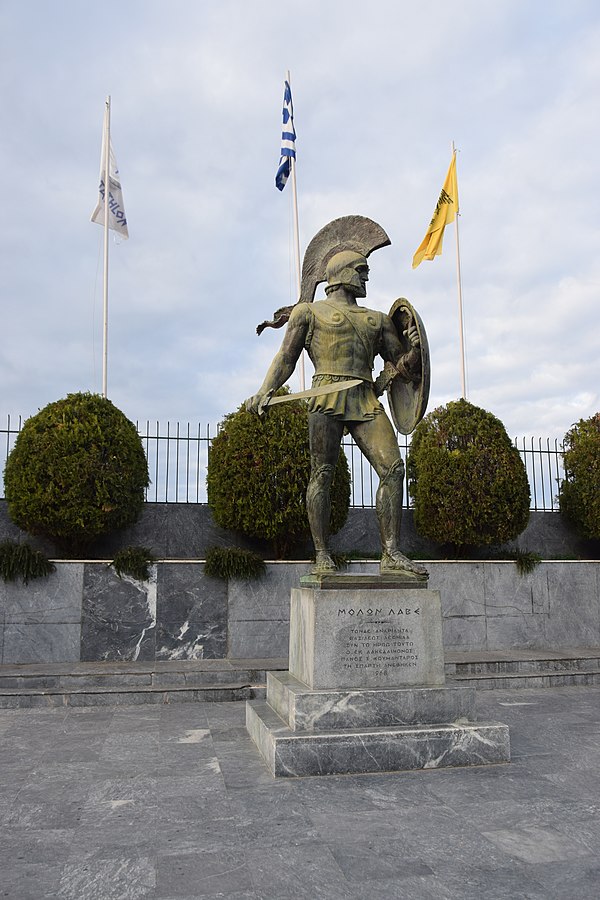
Despite it technically being a Persian victory, the Battle of Thermopylae shook the Greek world and served as a major rallying point for the rest of the war. It is still the best-known event of the Greco-Persian Wars, with it being famously depicted in the movie and graphic novel, 300. The 300 Spartans and 700 Thespians became martyrs, and the battle demonstrated to the Greek cities that despite being heavily outnumbered they could still put up an effective fight against Persia. The war would continue for another year, but would ultimately be unsuccessful for the Persians.
Links
The Battle of Thermopylae, at the World History Encyclopedia
 muscularhistory.com
