The Battle of Plataea
In the summer of 479 BCE the Greeks assembled an enormous army from many different cities. Modern estimates give a total of 80,000 Greek soldiers in total, led by 10,000 Spartans. They encamped their army in a defensive position on the hillside near Plataea, where the Persians would soon attack. Mardonius led an even bigger force of Persians. With the Theban allies, the Persian army numbered about 100,000. The Persians still used light wicker shields and short spears, which were heavily outmatched by the Greek’s heavy bronze armor and shields and longer spears. Despite the Persians’ greater numbers, they were at a disadvantage in a long, stand-up battle.
The two armies stood, facing each other for some time. The Persians had a large contingent of cavalry, and the Greeks did not want to enter the field and let themselves be outmaneuvered. Conversely, the Persians did not want to attack the Greek position, remembering the lessons of Thermopylae. The Persian army eventually managed to capture the spring which provided the Greeks with water. Knowing that they could not hold their position for much longer, the Greeks decided to fall back. As the army was made of so many different city-states, the retreat was rather disorganized. Seeing the chaos among the Greeks, Mardonius attacked.
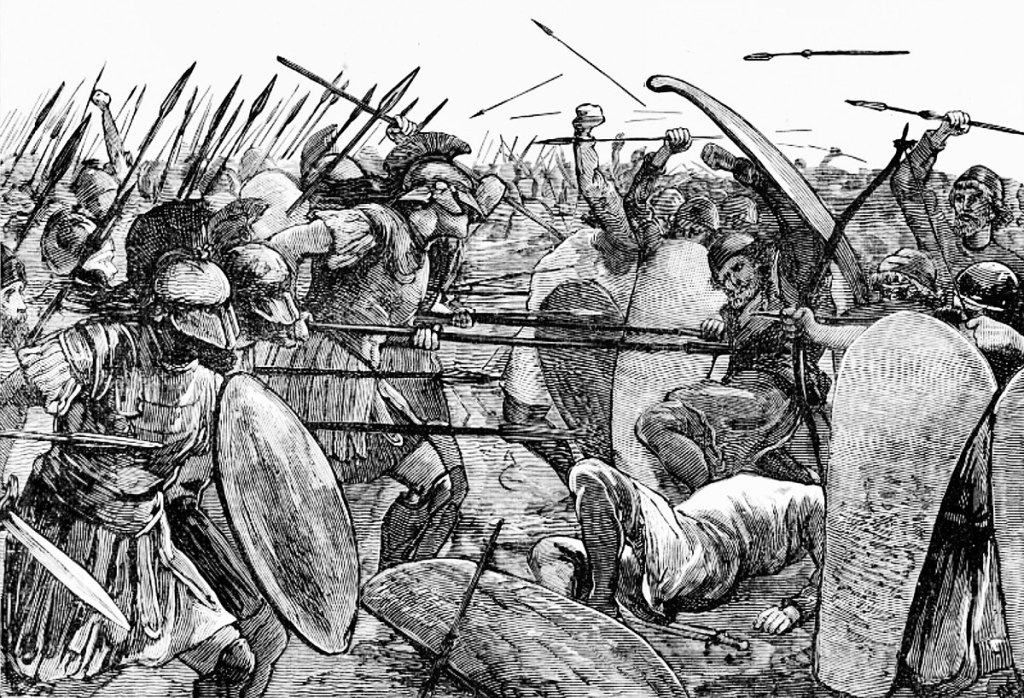
The Persian cavalry attacked the Spartans, but were repulsed while the Theban hoplites fought the Athenians. After the cavalry retreated, the Persian archers loosed massive volleys of arrows at the Greeks. Much like at Thermopylae, the arrows were of very little effect against the Greek shields. All it really accomplished was, once again, to give the Greeks some shade while they fought. After the rain of arrows, the Spartans charged down the hill.

The Spartans tore through the Persian army and killed Mardonius, while the Athenians triumphed over the other flank, guarded by Persia’s Theban allies. The bulk of the Persian army retreated to their camp, but they were chased by the Greeks. After a last stand at the walls of the Persian camp, they were slaughtered by the Greeks. Of the whole army, about 43,000 Persians survived. This marked the end of the war on the Greek mainland.
The victorious Greeks took the bronze weapons on the Persian army and melted them down, reforming them into a statue of three serpents intertwined into a column. This trophy was placed in Delphi as an offering to the god Apollo. It remained there for eight hundred years, until the Roman emperor Constantine moved it to his new city of Constantinople in 324 CE. It still stands in Istanbul to this day.

The Battle of Mycale
The same day as the Battle of Plataea, another battle took place at the shore near Mount Mycale. This was in Ionia, a region of Asia Minor with cities that were culturally Greek but under Persian domination. The Persians had landed their damaged ships on the beach, looking to avoid a fight when they were vulnerable. The ships were guarded by an army of 60,000 men, who had built fortifications to further protect the fleet.
The Persian ships were soon spotted by a Greek fleet under the command of the Spartan king, Leotychides. He made contact with the Ionians, asking for their assistance in fighting the Persian forces. While they did not join immediately, this also had the effect of making the Persians distrust their Greek allies. Herodotus noted that they sent away their Greek contingent from Miletus, and took away the armor from their Samian allies.
The Greeks made landfall, and the soldiers onboard the ships prepared to attack the beached Persian fleet. They had a total of about 20,000 troops, which they divided into two forces. One, led by Athens, attacked from the coastline, while the Spartans struck from the mountains. Despite being outnumbered three-to-one, they surrounded and beat back the Persians standing guard. The disarmed Samians joined the Greek army partway through the battle, and helped to swing the balance of power. They destroyed the Persian ships, and consequently crippled the Persian Empire’s ability to control the sea.

Once victory was achieved, the Greeks held a war council. Most of the Greeks wanted to relocate the Ionians, as they considered it impossible to protect them from further Persian aggression. This proposal was opposed by both the Ionians and the Athenians. The Ionians wanted to defend their home, and the Athenians believed their land to be and invaluable bulwark against the Persian Empire.
Aftermath
The twin victories at Plataea and Mycale were the biggest turning point in the war. There would be a few skirmishes as the Persians made their retreat, but there would be no more major battles. After this point, Persia no longer posed a significant threat to Greek independence. The allied Greeks worked to expel the remaining Persians from Greece, chasing them out of Sestos, capturing Cyprus, and taking Byzantium.
At this point, the Spartans returned to their own affairs, believing the job had been done. Athens, on the other hand, formed an alliance to prevent another invasion. In 478 BCE, Athens and its allies, including the recently independent Ionians, met on the island of Delos. As they had lost the support of Sparta and its subjects, they believed they needed greater cooperation to ward off Persian aggression. They founded the Delian League, taking their name from the island where they met but accepting the leadership of Athens. This organization would lead to Athens acquiring much greater wealth and influence. The next fifty years would be called the Athenian Golden Age. During this time, the Delian League waged war against the remaining Persian holdings in Greek lands, eliminating any trace of Achaemenid domination. In 451 BCE, a truce was finally agreed upon. After 41 years of on-and-off conflict, the Greco-Persian Wars finally came to an end.
Links
The Battle of Plataea, at the World History Encyclopedia
The Battle of Mycale, at About History
The Histories, Book IX, By Herodotus
 muscularhistory.com


