
Perseus was the son of Zeus and Danaë, the princess of Argos. Her father, Acrisius, was distressed by his failure to produce a male heir. He went to the Oracle at Delphi for advice, and was warned that his daughter’s son would one day kill him. To prevent this from happening, he locked Danaë in a bronze chamber, which was open on top but surrounded her on all sides. It would not work, though. Zeus soon visited Danaë in the form of a shower of gold, and impregnated her. Acrisius could not afford to offend the gods by killing his daughter and newborn grandson, but also did not allow them to stay. Instead, he locked both of them in a wooden chest and set them loose upon the sea, leaving their fate in the hands of Poseidon.
They washed up on the shore of Serifos, where they were found by the fisherman Dictys. He took them in and raised Perseus as his own son. Dictys’ brother, Polydectes, was the king of the island. He eventually pursued Danaë and attempted to marry her. Perseus, who was grown by this time, objected to his courtship, as Polydectes was a dishonorable king. To get rid of Perseus, Polydectes sent him on a quest to retrieve the head of the gorgon, Medusa.
Shortly after Perseus began his quest, the gods Hermes and Athena appeared before him. They told Perseus to seek out the Graeae, sisters of the gorgons. They did not know the location of Medusa, but they did know where to find a group of nymphs known as the Hesperides. These nymphs both knew the location of the gorgon and had some impressive items in their possession, which would make Perseus’ quest much easier.
The Graeae were three grey women who shared a single eye and tooth between them. Once Perseus arrived, they initially refused to help him. Rather than giving up, Perseus grabbed their eye as it was being passed from one sister to another. With the eye in his hand, he was able to force the grey women to tell him how to continue his journey. The Graeae told Perseus to travel northward to find the Hesperides. Having what he needed, Perseus returned the eye and continued on his way.
When Perseus visited the nymphs in the north, they gave him a pair of winged sandals belonging to Hermes. With these sandals, Perseus could travel extremely quickly and even fly. They also gave Perseus an indestructible magic bag called the kibisis and a cap belonging to Hades. This cap would turn the wearer invisible. Now having both the location and an arsenal of magical tools, Perseus traveled to Medusa’s lair.
Perseus carefully crept into Medusa’s lair, keeping himself hidden as much as possible. He guided himself with his mirrored shield, in order to guard against Medusa’s gaze. He quietly went up behind the Gorgon, and cut her head off. To his surprise, the winged horse, Pegasus, sprung forth from her body. Perseus knew he needed to hurry, as Medusa’s two immortal sisters were still alive and dangerous. He stuffed the head into his bag, leapt on Pegasus, and rushed out of the lair.

On his way back to Seriphos, Perseus came upon the land of Aethiopia. Here, he learned of their misfortune. Their queen, Cassiopeia, had boasted that her daughter, Andromeda, was more beautiful that any of the gods. In response to this blasphemous claim, the gods demanded that Andromeda be chained to a rock. Here she would be devoured by the sea monster Cetus, who was renamed the Kraken in the film, Clash of the Titans. The Kraken is actually a sea monster from 18th century Scandinavian legends. Perseus and the king, Cepheus, agreed that if the hero could rescue Andromeda, he would have her hand in marriage.
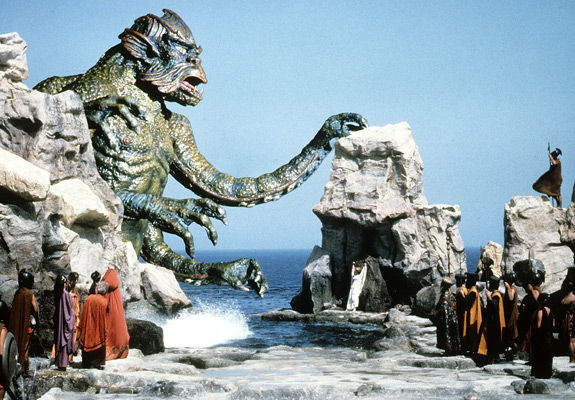
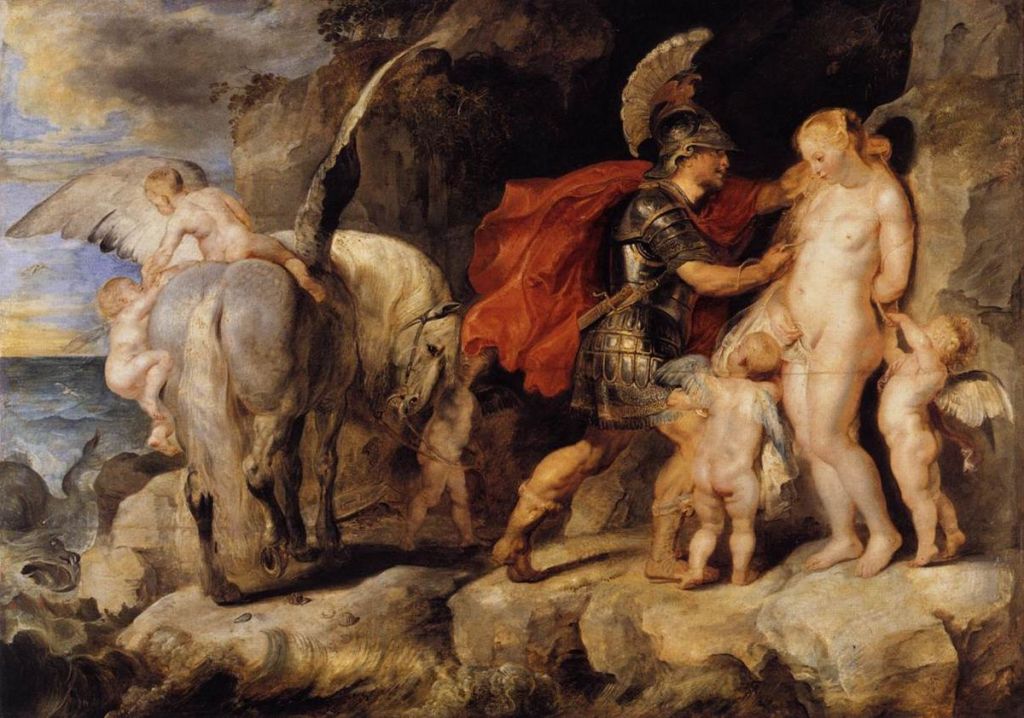
Perseus flew on Pegasus to the rock where Andromeda was chained. Right when he arrived, Cetus rose from the waves and moved toward Andromeda. Without a minute to spare, Perseus flew in front of the enormous monster’s face. Being careful to avert his gaze, he pulled Medusa’s head from his bag. The beast quickly turned to stone. With Andromeda saved, to two returned to Aethiopia, where they were married.
Perseus and Andromeda then traveled to Seriphos together. When they arrived, Perseus saw that Polydectes had been using his absence to attempt to force Danaë to marry him. In response, Perseus pulled out Medusa’s head and turned the king, as well as his attendants, into stone. With this, Dictys became king of Seripos, and the island had a good and honorable ruler. Perseus had no further use for his divine weapons, so he gave them to Athena. He also gave her Pegasus, which she would use for many years, and Medusa’s head, which she put on the front of her shield, aegis.
The Oracle at Delphi’s prediction did eventually come true, as did all of her prophecies. Acrisius was visiting the city of Larissa, where a series of games was being held. Perseus happened to be competing in these games. When he threw his discus, it was caught by the wind in mid-flight. It blew into the stands, and struck Acrisius in the head, killing him instantly. No matter what you do, the Oracle’s prophecies are inevitable.
Even accidental killings required exile, so Perseus did not take the throne of Argos, despite being next in line. He gave rulership of the city to his cousin, Megapenthes. Perseus and Andromeda went their own way, and founded a heroic legacy. They eventually founded the city of Mycenae, which they ruled for the rest of their lives. Their son, Electryon, would succeed Perseus as king. Electryon would have a daughter named Alcmene, who was best known for being the mother of Heracles. Mycenae itself would become an immensely important city. Many years later it would lead the Greek alliance in the siege of Troy.
Perseus was one of Greece’s greatest heroes. He defeated fearsome monsters, saved his mother from Polydectes, and founded an influential city. His adventures today are best known for their portrayal in the 1981 film Clash of the Titans, as well as its 2010 remake. Thanks to this movie, he is still well-known today, probably second only to his great-grandson and half-brother, Heracles. If you want to read the ancient sources, check out the links below.
Links
Bibliotheca, by Pseudo-Apollodorus
The Description of Greece, by Pausanius
 muscularhistory.com