In the third century BCE, Rome was expanding its influence. After defeating Pyrrhus of Epirus in 275 BCE, the Romans now ruled the Italian Peninsula. They wished to settle on Sicily, which was an important location for trade. However, another Mediterranean power was also interested in Sicily. Carthage, located in modern day Tunisia, was about to come into conflict with Rome. Their battles would shape the course of Mediterranean history.

The city of Messana was a neutral state on Sicily. After being conquered by a group of Italians called the Mamertines, its new owners started to look for allies to protect them from the various powers in the region. They first accepted an alliance with Carthage, in exchange for allowing the Carthaginians to set up a garrison in their city. This did not last long, however. The Mamertines soon formed an alliance with the Roman Republic, and told the Carthaginian garrison to leave as they would soon be replaced by Roman soldiers. Offended by this move, Carthage formed an alliance with nearby Syracuse and launched an attack. With the Battle of Messana in 264 BCE, the First Punic War began.
Carthage and Syracuse were soon forced out of Messana, which fell under Roman protection. Rome soon captured more cities in Sicily. Early in the war, a Roman army under the command of consul Manius Valerius Maximus Messalla surrounded Syracuse. Knowing that Carthaginian forces could not reach them in time, the Syracusans surrendered and were forced to switch sides.
Like the earlier Peloponnesian War, the two sides had asymmetrical strengths and weaknesses. The Romans were excellent warriors on land, but had little experience fighting on the sea. By contrast, the Carthaginians had a strong navy, but were not as good at fighting on land. The balance of power was reminiscent of the Peloponnesian War. With two sides that were similarly powerful, but in different ways, the war lasted for a long 23 years.
The war was fought mainly at sea. By this time, the trireme had fallen out of favor as the main warship and was replaced with the larger quadrireme and quinquereme, with four and five decks, respectively. Rome did not have much in the way of a fleet at the time the war began, but eventually captured an intact Carthaginian vessel and copied its design to make a sizable navy. At first, Carthage had a huge advantage in navel engagements, but in 260 BCE the Romans found a way to level the playing field.
Starting at the Battle of Mylae, the Romans equipped their ships with a device called the corvus, which is Latin for “raven.” It was a large plank with a spike on the end, which was in the shape of a raven’s beak. The Romans would bring their ships alongside the Carthaginian vessels and lower the corvus, linking the ships together and forming a bridge. Roman soldiers would then rush across to the Carthaginian ship and fight the battle as if it was on land. This brilliant innovation turned the tide of the war. From the victory at Mylae, the Romans chased the Carthaginians to Sardinia, where they won another victory. These twin battles destroyed much of the Carthaginian fleet.

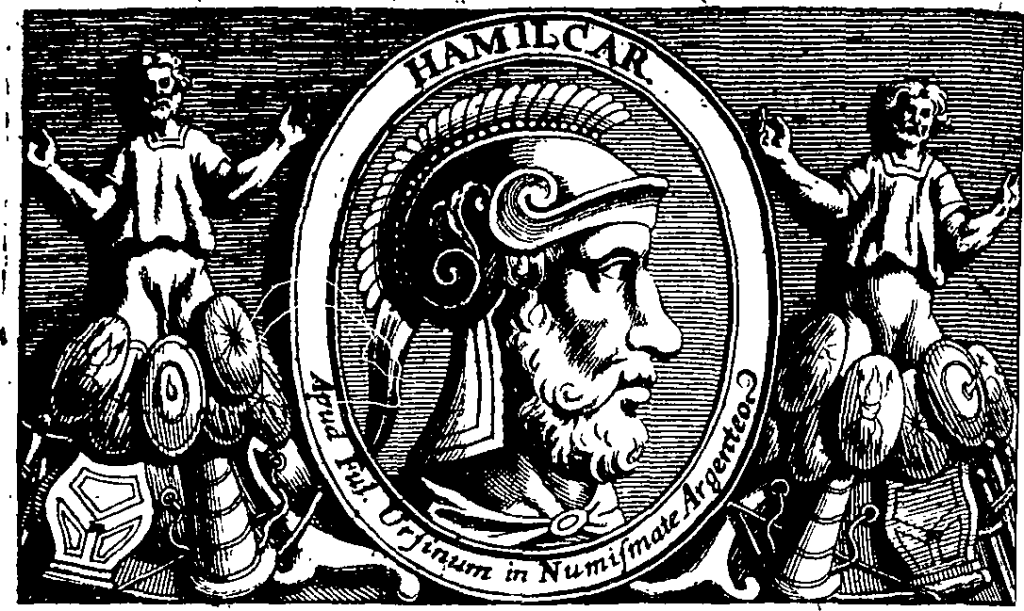
One of Carthage’s greatest generals was Hamilcar Barca. He led the defense of Sicily. As he lacked the resources to defeat the Romans on the island, he focused on forcing a stalemate. He avoided conflict whenever possible, working to make life difficult for his enemies by being impossible to remove. He used guerilla tactics to weaken the Roman forces while conserving his own. While his strategy and tactics were brilliant, there was only so much his operations could do to affect the course of the war. Despite Hamilcar’s efforts in Sicily, the Romans were free to wage war elsewhere.
In 241 BCE, Rome defeated Carthage in a naval battle at the Aegates Islands. Lacking the resources to continue the decades-long war, Carthage sued for peace. Rome gained control of Sicily, and Carthage was forced to pay steep war reparations. They signed to Treaty of Lutatius, under which Carthage agreed to abandon Sicily and pay 3,200 talents of silver over ten years.

In Carthage’s weakened state, its mercenaries and conquered territories erupted into rebellion. The mercenaries were owed payment for the war, but Carthage’s leader, Hanno, refused to pay them. Carthage tried to negotiate, but when it looked like they might reach an agreement, fighting broke out, with the mercenaries led by Spendius and Matho. Carthage’s conquered subjects in Libya and Sardinia saw their opportunity and joined the rebellion. At first the rebels had great success in the battles, but that changed when Carthage appointed Hamilcar Barca to lead its armies against them. Hamilcar had great success against the rebels, crushing their forces with a much smaller army.
In 237 BCE, Carthage tried to recover Sardinia from the rebels. However, Rome considered this an act of war. Carthage was in no position to wage another war at this time, so it acceded to Rome’s demands. They abandoned Sardinia, as well as Corsica, and Rome seized the islands. Carthage agreed to pay an additional 1,200 talents of silver as part of their war reparations.
Despite this setback, the successes in northern Africa allowed Carthage to begin to expand in territory and in power again. Hamilcar led a successful expedition to take land in what is now Spain. The many silver mines of the Iberian Peninsula brought much wealth to Carthage. During the conquest, Hamilcar was killed in battle against the Oretani tribe. His son, Hannibal, would soon take over his army. Hannibal would eventually prove to be an even more successful general than his father had been, dealing Rome some of the greatest defeats it would ever suffer in its history. Carthage had lost the First Punic War, but was far from defeated. Tensions with Rome were still high. The Second Punic War would soon come.
Links
The First Punic War, on the World History Encyclopedia
Corvus, at Livius.org
 muscularhistory.com