Roman warfare underwent many changes throughout Rome’s history. Early in the city’s life, its armies were arranged around the phalanx in the same manner as most other Mediterranean cities. Starting with the Second Samnite War, circa 315 BCE, the phalanx was phased out in favor of the more flexible legion.
The war was fought in Samnium, a region in the south of Italy which had rough, mountainous terrain. This made the traditional phalanx rather unsuitable, as it was nearly impossible to maintain a close formation under such circumstances. The Samnites fought in a much more adaptable formation called the maniple. After suffering multiple defeats, the Romans abandoned the phalanx and decided to copy the Samnites, adopting the maniple for themselves. Upon fielding their reorganized army, the Romans had a great deal more success. The war would continue for the next eleven years, with the Samnites suing for peace in 304 BCE.
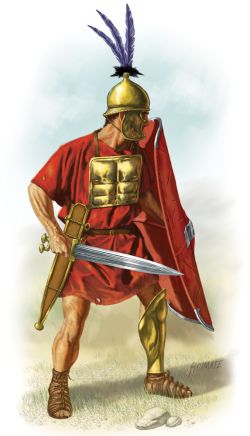
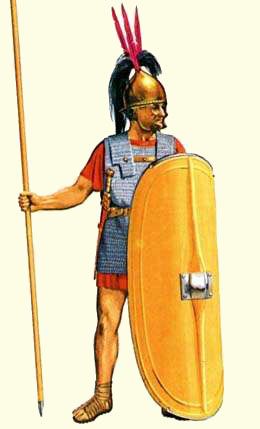
For most of Rome’s history as a republic, it arranged the legions into three main types of soldiers. The Hastati were younger men, who usually could not afford the best equipment. They formed the front line. The second line was the Principes. They were slightly older men with better weapons and armor. They were expected to stand and fight longer than the Hastati. The third and final line was the Triarii. They were older men armed with spears. They were wealthier than the Hastati and Principes, and therefore could afford the best equipment. They were the steadiest troops, only used when the Principes could not drive off the enemy. They were held in reserve as Rome’s last line of defense. Unlike the solid lines of the phalanx, the Roman lines were arranged in a checkerboard pattern. This formation allowed for far greater maneuverability on the battlefield.
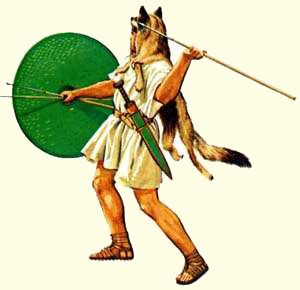
The Roman army also employed skirmishers called Velites. These were the poorest, and typically the youngest, members of the legion. They were armed with about seven light javelins known as veruta, singular verutum. These javelins were three feet long and about the width of a man’s finger. They would throw their veruta at the approaching enemy and then run behind the Roman lines. They carried a small sword as an emergency weapon, in case they found themselves in close-quarters combat. They had very little in the way of armor. They wore distinctive wolf fur headdresses which served more for identification than protection. The only true protection they had was a small circular shield. They relied mainly on their speed to keep themselves out of harm’s way.
The wealthiest members of Roman society fought as cavalry called Equites. Each legion would have 300 cavalry total, organized into ten groups of thirty horsemen. They wore chainmail, and carried a large ovel shield and spear. They are often overlooked today, as the Romans were best known for their infantry. They were a competent, effective force in their time, but were eventually phased out in favor of foreign auxiliaries.
The Greek successor states of Alexander’s empire had the custom of their generals micromanaging the battlefield on their own. The leaders wanted to follow Alexander’s example and lead their troops from the front. Rome put less emphasis on individual heroism and encouraged more initiative in their subordinates. Each leader of a maniple was trusted to make his own decisions. Additionally, Roman generals were more likely to stay in the back. Here, they could direct the battle from a better vantage point and in relative safety. The Greeks would have considered this practice cowardice. The Romans called it common sense.
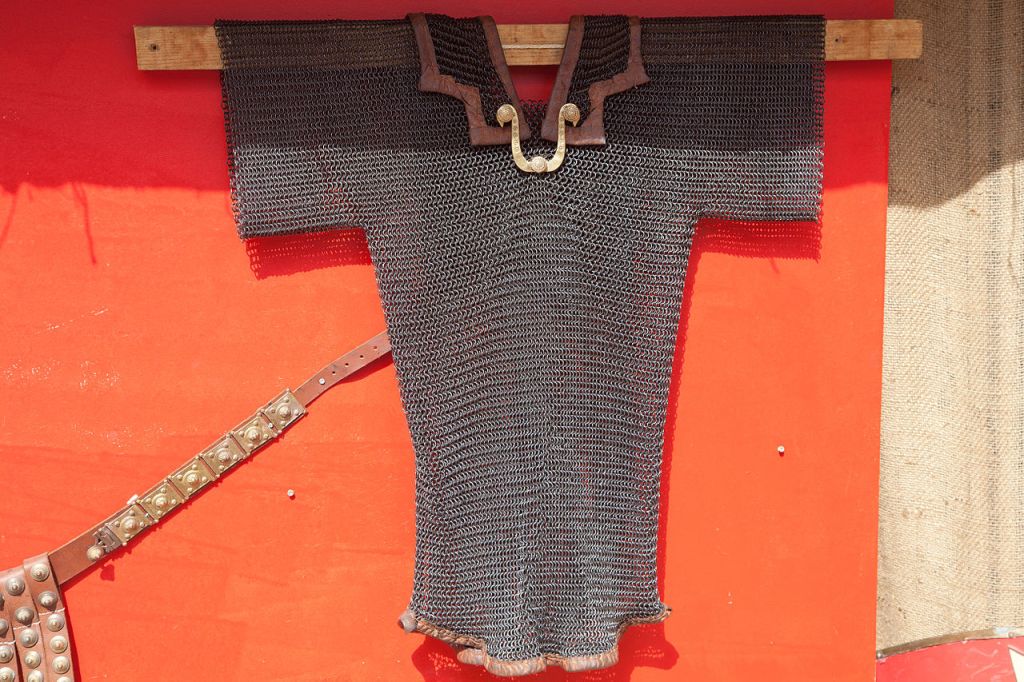
Hastati would usually wear a simple metal circle or square for protection, but Principes and Triarii were both armored with chainmail. The chain shirt, called lorica hamata, covered the soldier’s torso and left his arms and legs free. The rings were riveted together to grant it greater protection against stabbing weapons. A full set weighed about 24 pounds. Belts were used to distribute the weight. Otherwise, it would be piled on the shoulders and wear out the legionnaire more quickly. Despite later advances, lorica hamata remained in use throughout Roman civilization. It was low maintenance, as the constant friction from movement would keep the rings free of rust. Although it was labor intensive to make, a set could easily remain in use for decades. Even though the knowledge of how to make stronger armor existed, economics kept lorica hamata a viable option for many centuries.
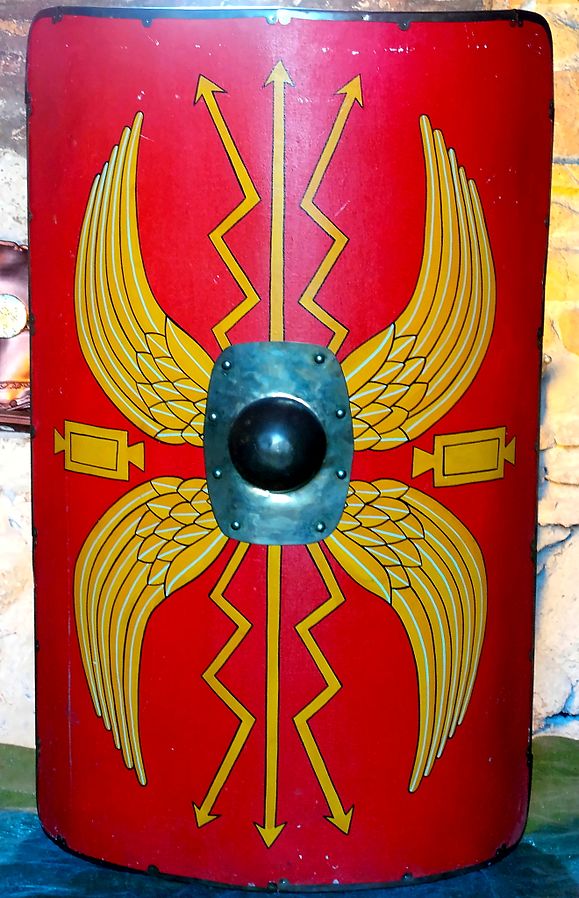
Like many other ancient armies, the Romans placed much emphasis on their shields. The Roman shield, called a scutum, was a convex wooden rectangle with a large metal boss in the center. It was constructed out of three overlapping layers of wood and lined with leather and canvas. The scutum was about 42 inches tall and 16 inches across, covering most of the soldier’s body. It weighed up to 22 pounds, making it an effective weapon in its own right when used to bash the enemy. The legions made heavy use of group formations with their scutum, including shield walls and the famous Testudo. Taking its name from the Latin word for “Tortoise,” the Testudo had the legionnaires forming a wall on the front and sides of the unit with their shields while the soldiers on the inside formed a roof. This formation was virtually impenetrable to arrows and javelins.
The main weapon of a Roman legionnaire was the gladius, a sword about 22 inches long. It had a straight blade and was designed for stabbing. Both the Hastati and the Principes used the gladius, whereas the Triarii fought with six-foot-long spears. However, the Triarii still each carried a gladius in case their spear broke. The combination of the gladius and scutum made the Roman legionnaires much more adept at fighting in tight formations. They were not intended to fight on their own, as many of their opponents did, such as the Celts. Rome conquered most of Europe by having superior tactics, whereas the barbarians mainly focused on having the strongest individual soldiers.
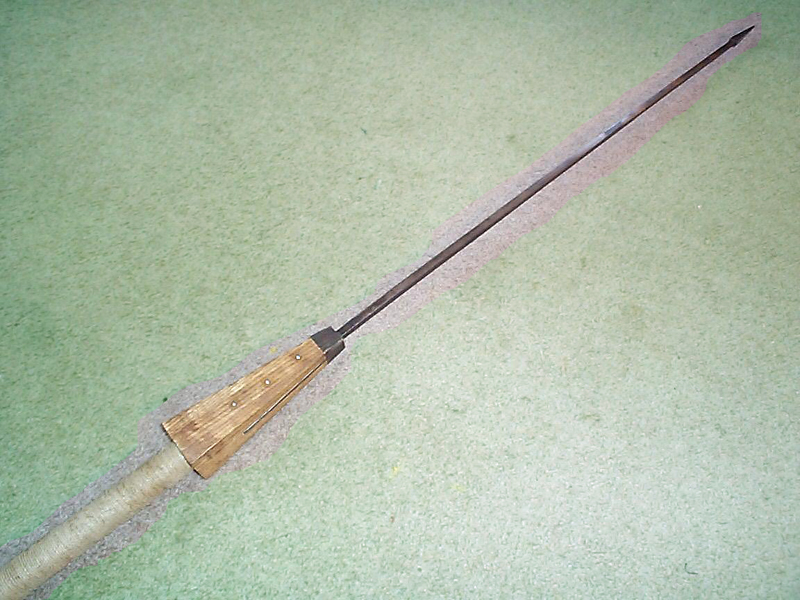
One of the most distinctive features of the Roman military was the use of the pilum. The pilum, plural pila, was a javelin with a thin iron shaft making up about 2 feet out of its six-and-a-half-foot length. Each legionnaire carried two pila with him. Before hand-to-hand fighting commenced, the legionnaires would all throw their pila in unison. Ideally, this would kill the enemy soldiers. However, even if they raised their shields they would still be at a serious disadvantage. The pilum would be lodged in the shield, rendering it too damaged to be used in the battle. The enemy soldier would be forced to discard it. Additionally, the soft iron shaft would bend on impact, making it impossible to be thrown back at the Romans. The pilum was an ingenious weapon that helped to ensure Roman dominance on the battlefield.
The Roman army used the manipular legion to great effect. With their military in this form, they took control of all of Italy, conquered Greece, and defeated Carthage in the three Punic Wars. Despite its effectiveness, they were still just part-time citizen soldiers. With the reforms of Gaius Marius at the end of the second century BCE, Rome would create a professional standing army of even greater strength.
 muscularhistory.com


