Civilization in Egypt began, and was centered, around the Nile river and the nearby Faiyum Oasis. The land around the riverbanks was fertile enough to grow large amounts of crops, and the topsoil would be replenished every year by the annual flooding of the Nile. The Nile’s riverbanks were the only part of the country which was suitable for habitation. There was nothing but harsh desert in the east or the west. The west was literally considered the land of the dead, both for its inhospitableness and the fact that the sun sets in the west. The dead were referred to as “westerners” in Egyptian speech. The east was considered the land of the gods, as the sun was renewed and rose in the east every morning.
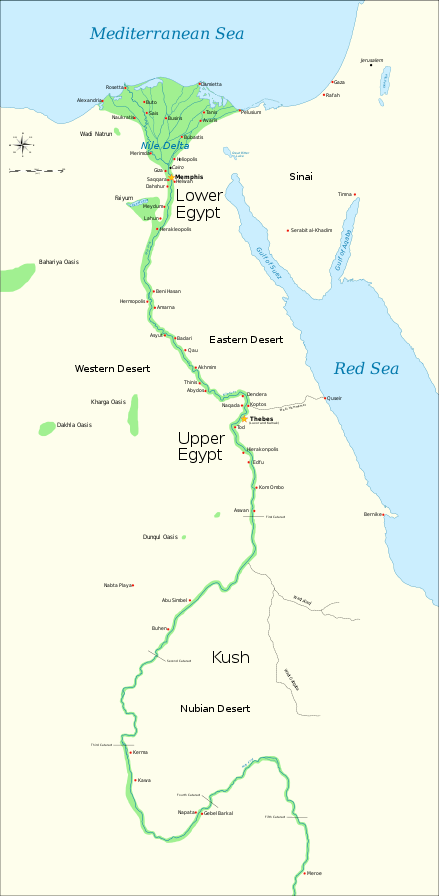
The land was divided into two parts: Upper and Lower Egypt. Contrary to what you are probably assuming, Upper Egypt was to the south and Lower Egypt was to the north. They were named as such because Upper Egypt was uphill in relation to Lower Egypt. The first Pharaoh was Narmer, also known as Menes. He managed to unite Upper and Lower Egypt into one polity circa 3100 BCE. United Egypt would spread from the Mediterranean Sea in the north to the city of Aswan in the south. It would not extend very far either to the east or the west. It was rather difficult to go very far into the desert on foot, and camels would not be introduced to Egypt until after the Romans took over.
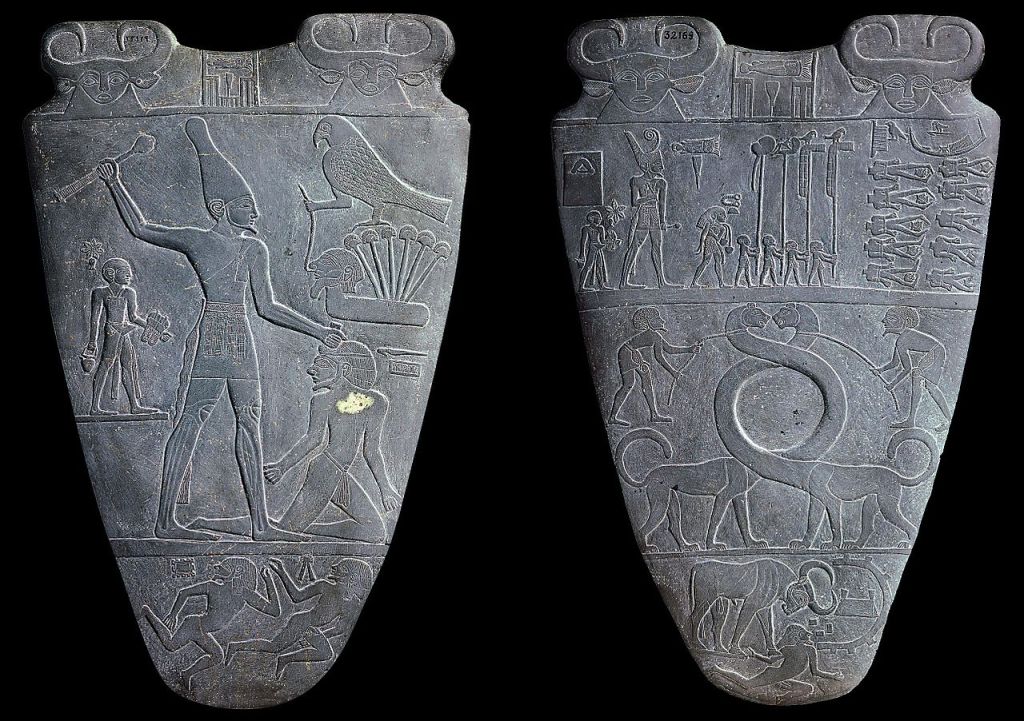
The many farmers around the Nile would send their surplus crops to the capitol, where they would be stockpiled in the case of a famine. This served as an early form of taxation. There was no actual money at the time, so farmers paid their taxes with the plants they had grown. Everyday trade was handled by a barter system. The existence of taxation meant that the Egyptians needed a way of keeping track of payments. They did this by developing hieroglyphs. They wrote in pictures, but they were not pictograms. A picture of a bird did not represent that bird. Instead, each picture represented a sound, in the same manner as our letters do today. When someone’s name was written down, it was marked with a barrier called a cartouche. It was given this name by French soldiers during the Napoleonic Wars, as it resembled a musket cartridge.

When you think of Egypt, the first thing that comes to mind in probably the pyramids, the monumental tombs built for the Pharaohs. The first pyramid ever built was for the Pharaoh Djoser, around the year 2650 BCE. It was designed by his Vizier, Imhotep. A Vizier was the Pharaoh’s right-hand man. He would handle the day-to-day affairs of the kingdom. Think of something like a Prime Minister. The Pharaoh was the ultimate authority, but a lot of tasks would be handled by the Vizier. This first pyramid did not have the smooth sides seen on the famous examples at Giza. Instead, it consisted of multiple tiers of square stone boxes. It is called the Step Pyramid for that reason. It is the first ever major stone building to be constructed.

The Pyramids at Giza known for being one of the Seven Wonders of the World. They are the oldest of the Wonders and the only one that is still reasonably intact. They are far older than most other ancient ruins. Built before 2,500 BCE, the pyramids were already ancient by the time of Homer. They were old when Minoan civilization first began to flourish on the island of Crete. When the pyramids were built, wooly mammoths still walked the earth on the isolated Wrangel Island off the coast of Siberia. They are incredibly old, but as mentioned above there are other pyramids in Egypt which are even more ancient. The three pyramids at Giza are considered the Wonder, though, because they are the largest and most elaborate of the Egyptian monuments.
The pyramids were built as tombs for pharaohs in the Old Kingdom of Ancient Egypt. Pyramid building began in the Third Dynasty and reached its zenith during the Fourth. Contrary to popular belief, the pyramids were not built by slaves. They were built by paid workers, in fact, it is thought that the pyramids served as large public works projects, providing employment for farmers in the off season. The first pyramid looked very different than its more famous successors at the Giza Complex. Built for the pharaoh Djoser, it consisted of a series of tiered layers, which created a step-like effect. Accordingly, it is now referred to as the Step Pyramid. By the time of the Giza Pyramids, the technique had been improved to the point that each pyramid had smooth sides.

The Giza Pyramid Complex contains three major pyramids, plus the Sphinx. They were built during the Fourth Dynasty. The largest and oldest of the three pyramids is the Great Pyramid of Khufu, who is also known as Cheops. It was originally 481 feet high, or 146.5 meters. Until 1300 CE, the Pyramid of Khufu was the tallest structure in the world. Its record was broken by the Lincoln Cathedral, 3,800 years after it was built. For comparison, 3,800 years ago was roughly when Babylon became the largest city in the world. The Pyramid of Khufu was built over a period of about 27 years by a large force of workers. We are not quite sure what methods were used to build it. We can assume that large earthen ramps were used to move the heavy stones, but we cannot know what form they took.

The second one of the pyramids at Giza to be build was that of Khafre, which originally stood 471 feet high, or 143.5 meters. Khafre was the son of Khufu, and he has the second-largest pyramid after his father. In many photographs, it appears to be the larger of the two pyramids. However, this is just an illusion caused by it being constructed on higher ground.

The third pyramid at Giza was built for Menkaure, who was the son of Khafre. His pyramid was significantly smaller than those of his father and grandfather, standing 213 feet, or 65 meters, tall. There is a gash in the pyramid, which was caused by an attempted demolition in 1196 CE. Al-Aziz Uthman, the Sultan of Egypt, ordered his men to disassemble the pyramids, but destroying them turned out to be far more difficult than they believed. They only managed to take away part of Menkaure’s pyramid before they gave up.

The complex also includes the Great Sphinx, which was built during the reign of Khafre. It is generally agreed among historians that the face on the Sphinx represents Khafre. The structure is 240 feet (73 meters) long, 66 feet (20 meters) tall, and 63 feet (19 meters) wide. This huge sculpture is one of the oldest in the world, and it was carved directly from the bedrock. Though it was built around the same time as the Pyramid of Khafre, it received a restoration around 1400 BCE by the Pharaoh Thutmose IV.
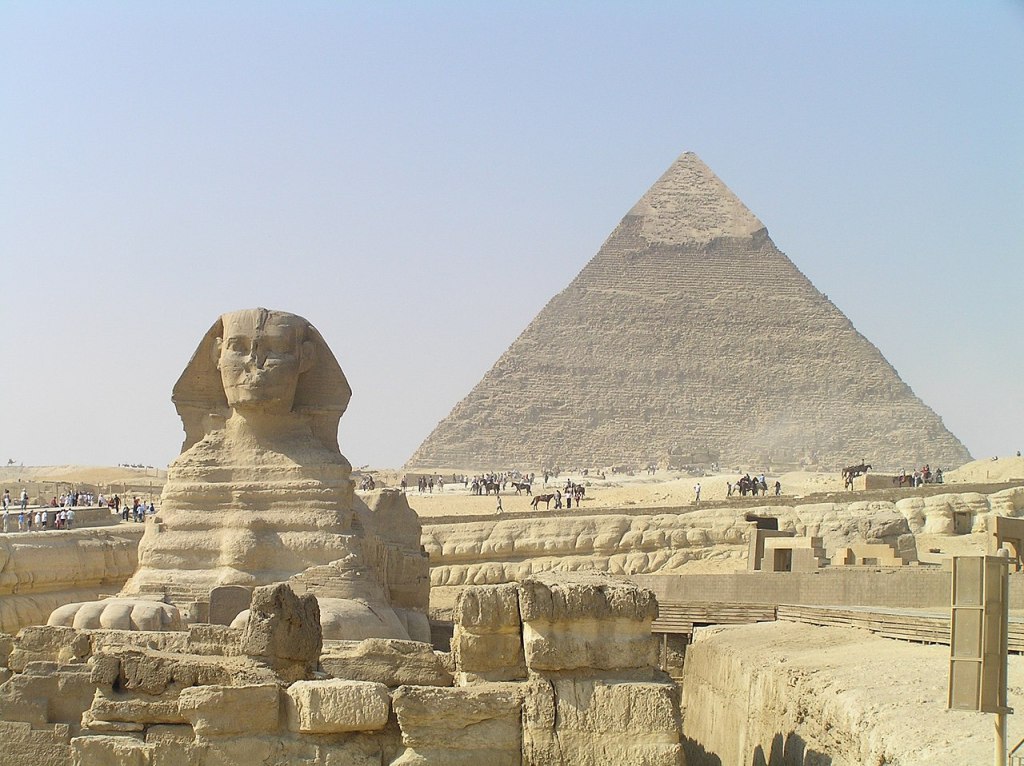
While these tombs were magnificent, their disadvantage was that they made exceptionally tempting targets for thieves. All three pyramids, plus the Sphinx, were looted in relatively short order. In an attempt to protect their tombs from graverobbers, later pharaohs made their tombs less accessible. They were buried underground in different locations, most notably in the Valley of the Kings. This had mixed levels of success, many tombs were looted over the years, but the tomb of Tutankhamun remained untouched until its discovery by the archaeologist Howard Carter in 1922.
Considering their immense age, the Pyramids at Giza are remarkably intact. Some elements are missing, such as the white limestone which originally coated all three pyramids, and a few blocks have been removed from each of them. Not to mention the treasure from the inside of the pyramids. But even with these things missing, they remain some of the most incredible structures in the world. They are a true wonder, even by today’s standards.
Links
The Great Pyramid, at the World History Encyclopedia.
The Great Sphinx, at the World History Encyclopedia.
The Old Kingdom, at About History.
 muscularhistory.com
